I feel a little self-conscious about choosing a book called ‘The Virtue of Selfishness’ as our first book - and as an introduction to all of you - so I wanted to explain a little about how I came to this choice.
Broadly, and from my standpoint, much of the national dialogue is non-sense meant to distract attention, confuse the mind and inflame the emotions. For someone like me, who is always trying to analyze and make sense of my world, it’s a special kind of hell, from which the only remedy is to map and dissect the arguments, one premise at a time.
In this case, the premise I’m interested in examining is that competition and cooperation are at opposite ended of a spectrum, mutually exclusive, and having nothing to do with each other. My instincts tell me that it’s the balance between these two poles - the middle way - that is the best, but then I remembered a friend of mine siting this book years ago.
I chose this book for the following reasons:
1. I am interested in the idea that the biggest divide in our country today is, and maybe always has been, an existential war between the Pinko, Snowflake Socialists and Gun-Slinging, Sociopathic Capitalists. That is to say, between those whose point of reference is "We" and those whose point of reference is the "I".
I am a fierce proponent of the Middle Way, and feel I have a firm grasp on the importance of the "We" and the dangers of the "I", but I have to say I am woefully underschooled on the reverse.
2. Ayn Rand came of age during the Bolshevik Revolution in Russia, so she seem uniquely qualified to discuss this topic of the before/after affects of communism - albeit Leninst not Marxist.
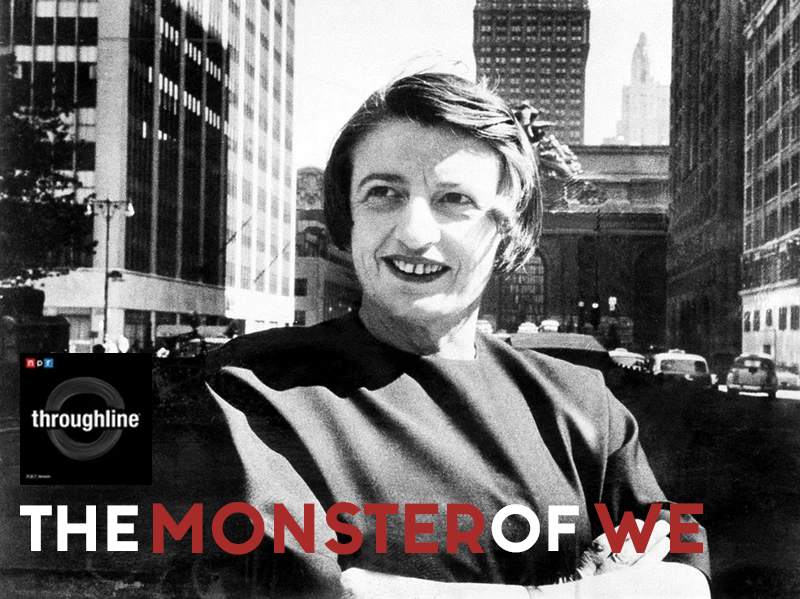
3. Ayn Rand is a controversial writer, is typically touted by politicians I find distasteful, and the title of this book is extremely provocative. Below are links to Throughline's Podcast "The Monster of We", where Stanford University historian Jennifer Burns walks through Rand's evolution and how she eventually reshaped American politics.